IT CAN BE A LITTLE INTIMIDATING walking into a church for the first time. Or maybe it’s just been a long time (like 30 years ago when your mom dragged you to Sunday School). A lot has changed since then. The songs are singable, the homily understandable (we hope), and you don’t need to come in a suit. (By the way, we’d like to thank you for checking us out today.) This explanation may help shed some light on aspects of our church. We hope you’ll find the material on our website interesting, entertaining, even challenging. After all, we hold that Jesus Christ came to take away your sins, not your mind. You are unconditionally welcome here! We look forward to seeing you.
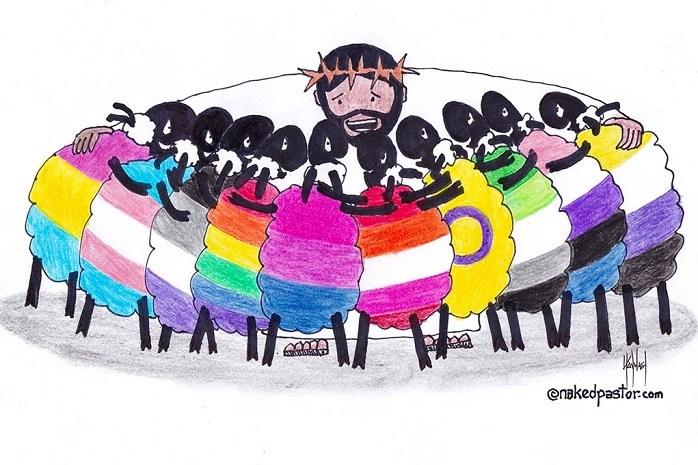
At the parishes of the Affirming Catholic Church of Christ we value diversity to learn from one another in a safe space sharing the radical love of Jesus Christ with EVERYONE!
Comprised of all ages and backgrounds, from those in the pews to those participating in various aspects of the Mass, in our oneness and our differences, we gather together with a common commitment to the Gospel message of Christian love, social justice, and radical hospitality. Everyone is welcome to fully participate in ALL sacraments of the church regardless of marital status, race, sexual orientation, gender, gender identity, nationality, age, criminal background, or past. We are an open and affirming church that seeks to be a spiritual home for ALL people wherever they are on their spiritual journey.
If you would like to help us shape our warm and progressive faith community, we welcome you to join us for worship. Come and be yourself. There is room here for the individual, the activist, the thinker, and the questioner. At the Affirming Catholic Church of Christ, we all have a story to tell & welcome YOU to add to that story. We will be gifted by your presence!
Affirming Catholic Church of Christ… What does that mean?
Affirming: The word “Affirming” is in the beginning of our name for two reasons. 1) Because we are! We “Affirm” that ALL of God’s people are not just welcome here, but loved and fully included in the life and ministry of the Church. Race, gender and gender identity, sexual orientation, socio-economic status, criminal background, history of or currently suffering from any form of addiction, Republicans, Democrats, Flat Earthers, believers in Aliens, even those people who put pineapple on pizza….ALL are welcomed and loved! 2) The word “Affirming” is first so that instantly those who have been so hurt by religion in the past feel safe and know that this is not just another Church, but a safe haven…a home.
Catholic: So we are Roman Catholics who have to do whatever the Pope says and we see the Virgin Mary in our morning cereal, right? Nope. Sorry. Although it would be pretty cool to see the Virgin Mary at any time and in any place! The term “Catholic” refers to a universal body of believers. Unified in our faith and in our beliefs. When we say we are the “Catholic Church” we are not saying we are Roman Catholics (far from it), but instead we are saying we are Universal. We are United. We are Strong. We (the believers, the body of Christ) WE are the Church. From all over the planet we are United as one in Christ Jesus.
Church of Christ: Isn’t that a Christian Denomination? Yup, sure is. But that’s not us folks! We believe ourselves to be a continuation of the One, Holy, and Apostolic Church established by Jesus Himself. As such, we enjoy authentic and verified Apostolic Succession, tracing our roots and authority all the way back to St. Peter. We truly are, THE Church of Christ.
So come as you are to Mass. Come and be accepted, come and be loved, come and experience the compassion and inclusion that you have long sought, yet so many other Churches or “Christians” have denied you. Even you strange people who like pineapple on pizza! There’s always room for you too.
When people hear the word “catholic” they automatically think “Roman Catholic,” and this is understandable. Most Catholics people encounter are of the Roman variety and Roman Catholicism is the largest single body of Christians in the U.S. But, in fact, Roman Catholics are not the only kind of Catholics in the world and never have been.
The most visible Catholic churches of the non-Roman variety are the many Eastern Orthodox churches, which are largely national in origin. The Russian Orthodox, the Byzantine Catholic, the Armenian Orthodox, the Greek Orthodox, Syrian Orthodox, and many others – all are Catholics, and all are completely independent of Rome. They call themselves “autocephalous” (self-headed), which simply means, “appointing its own leaders.”
There are non-Roman Catholics in the West as well. The world-wide Old Catholic Communion broke from the Roman Church in 1724 and has member churches in many European countries. Similarly, the Anglican Communion of churches extends to nearly every country on earth. They have the unusual distinction of being both Protestant and completely Catholic.
Old Catholic/Independent Catholics are the fastest-growing variety of Catholics in the West. We are found in nearly every city of every state in the U.S. and Mexico, every Province of Canada, and throughout Australia, Europe, and South America. Many pockets of Independents look very much like Romans, some very much like Orthodox, and some very much like Anglicans. And that is to be expected. Many of our members come from these various jurisdictions.
As one might expect from the label “Independent,” the Independent Catholic Movement does not come under the authority of the Pope or the Roman Catholic Church. However, independent churches still claim the label Catholic, which comes from a Greek word, katholikos. This word means ‘universal’ and describes any community that takes part in the universal church under Jesus Christ. It also often suggests a particular approach to Christianity — sacramental, ecclesial, led by bishops, and concerned with tradition in addition to Scripture. There are several precedents for this kind of autonomous Catholicism, not least of which being Eastern Orthodoxy. The Orthodox claim to be part of the “One Holy Catholic and Apostolic Church” by confessing the Nicene Creed, and they are self-governed, looking to several significant Patriarchs (especially the Patriarch of Constantinople) for guidance. The Anglican Church, which began as the Church of England under Henry VIII, is also part of the Catholic tradition and has a long history of independence from any one governing authority. Independent Catholic communities run the gamut from very conservative to very liberal, with a variety of different theologies and liturgical traditions.
Old Catholicism/Independent Catholicism is part of a much larger movement which includes Independent Orthodox and Independent Anglican churches. All three groupings are very broad, including those who have left Roman Catholicism, canonical Orthodoxy, or the Anglican Communion because they believe these churches have drifted either too far to the left, or too far to the right. However, it is also important to note that the barriers between Independent Catholicism, Independent Orthodoxy, and Independent Anglicanism are much more permeable than the borders between their canonical cousins. It is not uncommon to find priests who began as Independent Anglicans but now practice as Catholics under Independent Catholic bishops. There are also some jurisdictions and parishes that straddle the line, describing themselves as “Catholic Orthodox” and incorporating elements from both liturgical or theological traditions.
Christian unity is an important concern to Independent Catholic communities and something very much hoped for. Ecclesiastical and intercommunion agreements between the various jurisdictions are not uncommon. Because some of these groups are quite liberal, while others can be even more traditional than their mainline counterparts, these ecclesiastical affiliations do not require from either jurisdiction the acceptance of all doctrinal opinions, sacramental devotion, or liturgical practice characteristics of the other, but merely implies each believes the other to hold all essential elements of the One, Holy, Catholic, and Apostolic Faith.
In addition to serving an unchurched public, these independent groups often provide an alternative for people from Catholic, Orthodox, or Anglican traditions who feel alienated from their mother churches or who have “impediments” preventing them from receiving the sacraments. This is especially the case for those, who for whatever reason, have no church home and are in need of the services of a legally ordained member of the Catholic Clergy in valid Apostolic Succession. Most Old Catholic/Independent Catholic Churches also wish to reach out to those from the various Protestant and “non-Catholic” Christian traditions who are seeking to embrace a form of sacramental spirituality. The insistent emergence of those who feel rejected or alienated from mainstream Christianity dictate that we bring about revolutionary methods of ministering to those in need.
We are Catholic churches in the ancient, universal, sense of that word as well as in our form of sacramental worship. Our priests perform the liturgy and administer the seven sacraments, though each priest and bishop is given some flexibility in this.

Our Commitment at the Affirming Catholic Church of Christ
We stand as a testament to the continuity and preservation of the ancient faith. We are committed to upholding the teachings received from Jesus, carried forth by His Apostles and the Church Fathers. While we acknowledge the modern challenges facing Old Catholicism/ Independent Catholicism, we remain steadfast in upholding the faith while being attuned to contemporary societal needs.
Why Old Catholicism/Independent Catholicism Matters
The Independent Catholic Movement serves as a counterpoint to the shifting doctrinal landscape within the Roman Catholic Church and other modern reformed churches. For those seeking a spiritual home that aligns with historic Church teachings yet addresses modern challenges, Independent Catholicism, especially the Affirming Catholic Church provides a sanctuary.
GuidedbyAncientPrinciples
The Declaration of Utrecht’s First Article eloquently captures the core ethos of our movement, affirming our commitment to the principle laid down by St. Vincent of Lerins: “Id teneamus, quod ubique, quod semper, quod ab omnibus creditum est; hoc est etenim vere proprieque catholicum.” In essence, we hold steadfastly to the universally accepted faith of the ancient Church, as articulated in ecumenical symbols and dogmatic decisions from the ecumenical councils of the first millennium.
Conclusion
The Old Catholic/Independent Catholic Movement is not merely a historical footnote; it’s a living, growing community committed to the ancient faith of the Church. At the Affirming Catholic Church of Christ, we stand confident in the bright future of Old Catholicism/Independent Catholicism, united in our commitment to tradition and modern relevance.
Join us in our journey of faith. The Affirming Catholic Church of Christ welcomes all who seek a church that honors both ancient wisdom and modern needs.
 Welcome to the Affirming Catholic Church of Christ